Face tracking AR
Face tracking AR works when the audience wants to become part of the content
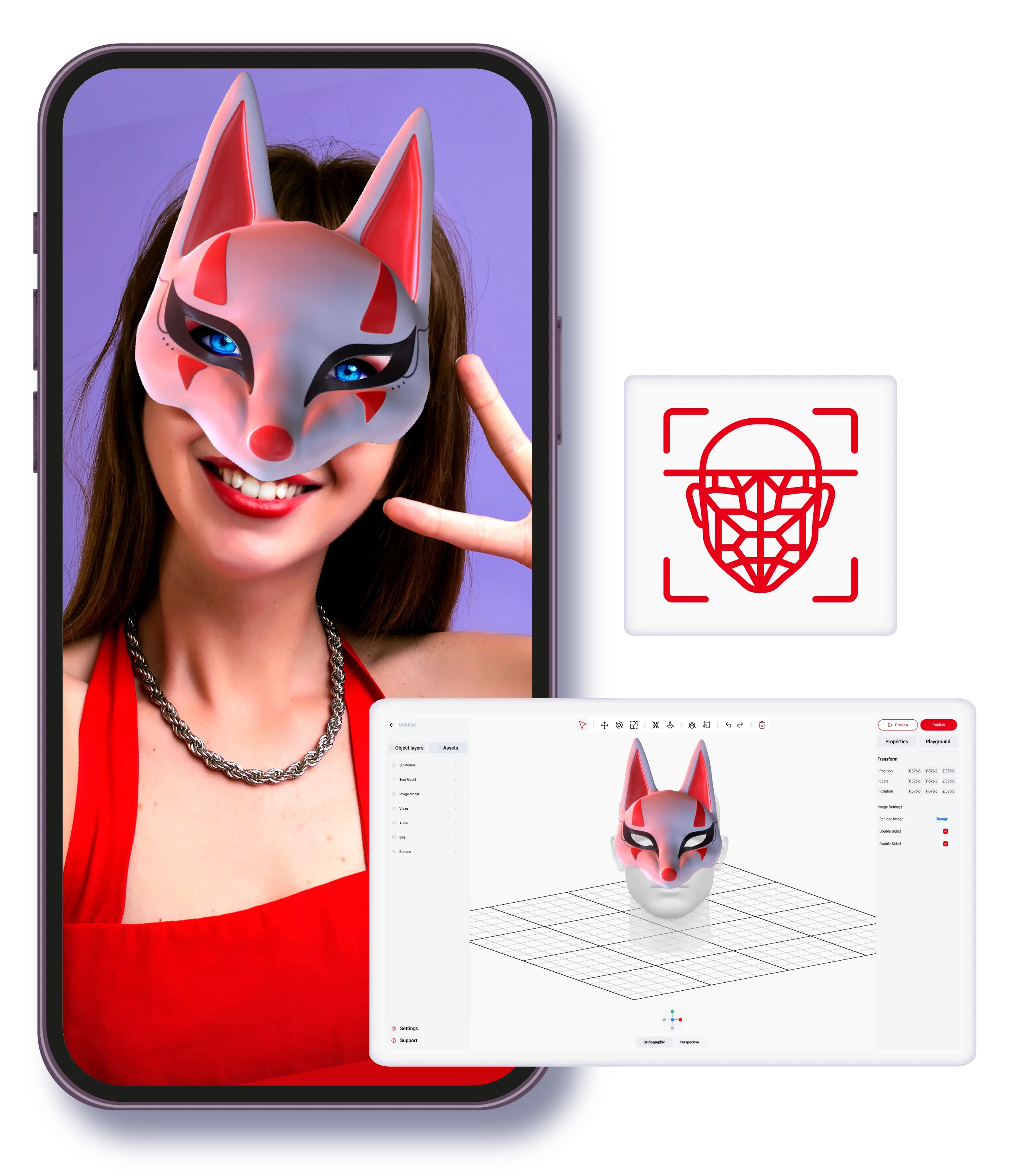
Face tracking AR is one of the most recognizable AR formats because it turns the user into the focal point of the experience. Filters, branded effects, make-up previews, character overlays, and social-style activations all sit inside this category. The format is powerful because it is immediate and personal, but that same immediacy means it should be used intentionally. The strongest face-tracking campaigns make the experience feel native to the brand, the audience, and the distribution moment.
Best for
Fashion, beauty, entertainment, events, fan engagement, and social-first branded experiences.
Why it works
The user becomes part of the story immediately, which can increase participation and sharing.
What matters most
Brand fit, visual polish, and a clear reason the effect should exist beyond novelty.
Format
Face tracking AR is about personal participation, not passive viewing
Unlike AR formats that place a model in a room or attach content to a printed marker, face tracking turns the camera toward the user. That changes the psychological role of the experience. The user is no longer just observing. They are testing, performing, reacting, or becoming part of the brand interaction directly.
This makes face tracking especially effective for categories where identity, style, and entertainment already matter. When the format fits the brand, the interaction can feel intuitive. When it does not, it quickly feels forced or forgettable.
- •Use face tracking when personal expression is part of the campaign value.
- •The closer the effect is to the brand world, the better the interaction tends to perform.
- •Short, clear, visually strong face-tracking moments usually outperform overly complex concepts.
Where it fits
The format is strongest in industries where appearance, identity, or fandom already matter
Fashion and beauty campaigns use face tracking to support previews, branded looks, and limited-time activations. Media and entertainment brands use it to turn characters, stories, or launches into interactive audience moments. Events use it to create sponsor activations, attendee engagement, and social sharing. In each case, the audience already expects visual participation, so face tracking feels relevant rather than distracting.
That expectation is important. Face tracking does not need to serve every audience. It serves the audiences that are likely to enjoy being visually involved in the campaign. The more naturally the format aligns with the brand relationship, the stronger the experience becomes.
- •Fashion and beauty brands can use it for branded looks, seasonal launches, or style previews.
- •Entertainment brands can use it for character overlays, promo moments, or fandom engagement.
- •Event teams can use it for attendee participation, social amplification, or sponsor-led effects.
Creative discipline
Face tracking AR fails when it chases novelty without a campaign role
Because face tracking is visually immediate, teams can be tempted to stop at the effect. That is usually the wrong move. The better question is what the interaction should achieve. Is it creating shareable brand reach? Encouraging product trial? Supporting a launch? Extending event participation? Building fandom? The creative decisions should follow that answer.
It is also important to keep the interaction easy to understand. Users should know what the effect does, what makes it worth trying, and what the next action is if the campaign expects one. That clarity is often the difference between a branded AR moment and a disposable effect.
- •Design for a single strong visual idea before adding secondary effects.
- •Give the audience a clear reason to try the experience and a clear outcome after it loads.
- •Treat face tracking as part of the campaign flow, not just an isolated visual toy.
Platform angle
ARLOOPA Studio helps teams ship branded face-tracking concepts without a heavy custom workflow
For teams that want to test face tracking inside a broader AR program, ARLOOPA Studio provides a useful no-code environment. That makes it easier to evaluate whether face filters, branded overlays, or campaign effects belong inside the activation mix without committing every experiment to a separate technical build.
From there, the natural move is to connect the format to the sector pages where it is most relevant. Fashion, media and entertainment, and event experiences all provide deeper context around the business goals that usually make face tracking worth pursuing.
- •Reduce production friction for campaign concepts that need quick iteration and stakeholder review.
- •Pair face tracking with broader AR formats when the campaign needs more than one interaction type.
- •Use the related sector pages to decide whether the effect belongs inside a larger campaign strategy.
Brand operations
Face-tracking AR succeeds when creative experimentation is balanced with approval discipline
Face filters and branded face-tracking experiences can move quickly from playful concept to public asset, which is why approval discipline matters. Teams need to review how the effect behaves across lighting conditions, face shapes, skin tones, front-camera quality, and campaign environments. They also need to confirm that the creative treatment fits the brand rather than relying on novelty alone. The strongest face-tracking work usually feels immediate and light, but it is still carefully tested before launch.
This is especially relevant for fashion, entertainment, and event activations where social sharing and visual consistency matter. ARLOOPA Studio helps because it gives teams a structured environment to build and review these experiences without moving every change through a heavy development cycle. That makes it easier to test multiple concepts, narrow the strongest option, and publish only what feels brand-safe and operationally reliable.
- •Review the effect across varied devices and real-world lighting conditions.
- •Use one strong visual idea instead of stacking too many face effects together.
- •Treat creative approval and QA as part of the campaign timeline, not a final check.
FAQ
Face tracking AR FAQ
What is face tracking AR?
It is an AR format that follows the user’s face and places digital effects, masks, overlays, or branded content on top of that tracked face in real time.
Which brands benefit most from face tracking AR?
Fashion, beauty, media, entertainment, and event-focused brands usually benefit most because self-expression and shareability are already part of the audience relationship.
Is face tracking AR only for social filters?
No. Social-style filters are common, but the format can also support brand activations, event moments, education, and campaign storytelling when used intentionally.
What makes a face filter campaign effective?
Strong visual polish, clear brand fit, low interaction friction, and a reason for the audience to try or share it.
Existing Studio pages
Related Solutions
Use these established Studio pages when you need deeper solution or industry detail beyond this guide.
Fashion
See how fashion brands use virtual try-on, WebAR, and 3D product visualization to launch interactive campaigns, product previews, and branded AR experiences.
Open pageMedia and Entertainment
Explore how media and entertainment teams use WebAR, face filters, interactive storytelling, and branded AR campaigns to create memorable audience experiences.
Open pageEvent Experiences
Create AR booth experiences, trade show activations, sponsorship layers, scavenger hunts, and product reveals with WebAR and no-code AR tools that increase attendee engagement.
Open pagePricing
Compare ARLOOPA Studio pricing plans for WebAR, geospatial AR, image tracking, and no-code AR creation, and choose the right option for your team or business.
Open pageContinue reading
Related Reading
These supporting guides answer the next practical questions readers usually have before launching an AR project.
AR Advertising Guide
AR ads are strongest when they deepen the campaign moment and lead naturally to the next action.
Read guideAR Marketing Guide
Use AR marketing when interaction improves understanding, memory, or action instead of adding novelty for its own sake.
Read guideAI for AR Creation
Use AI to reduce production friction in AR ideation and asset prep, not to avoid strategic decisions that still need human judgment.
Read guide