Use-case guide
Geospatial AR use cases are strongest when the place is essential to the message
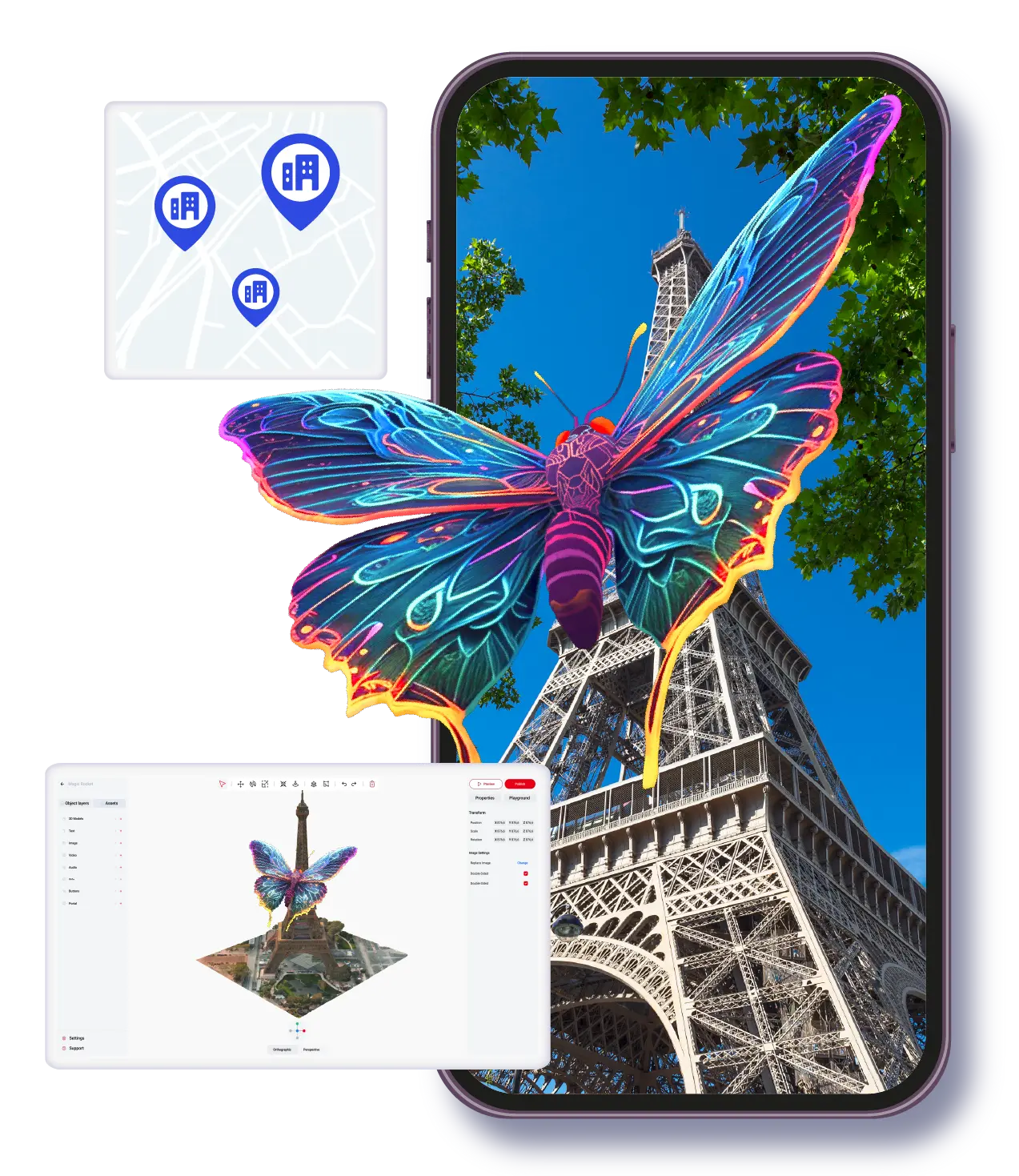
Geospatial AR only makes sense when the physical location adds real value to the experience. That is why the strongest examples are not generic campaigns placed outdoors. They are tourism, cultural, educational, and event experiences where the place itself carries history, meaning, orientation, or narrative. This page focuses on those practical use cases.
Strong fit
Destinations, cultural sites, campuses, public spaces, and large event environments with clear place-based stories.
Not ideal
Generic experiences where the location could be replaced without changing the value of the content.
Planning lens
Design the on-site journey first, then the digital layer that improves it.
Tourism
Tourism teams use geospatial AR to make destinations easier to explore and remember
Destination marketing and visitor experience teams can use geospatial AR to reveal local stories, historical overlays, route-based content, and context tied to specific landmarks. This helps transform a visit into a guided experience rather than a passive stop.
The practical win is that the digital layer belongs to the site. It adds depth to the physical journey instead of pulling the audience away from it.
- •Landmark storytelling and route-based discovery.
- •Destination interpretation for city or attraction visitors.
- •Tourist guidance that improves orientation without overwhelming the site.
Culture and education
Arts, culture, and education use place-based AR to attach meaning to the environment
Museums, cultural organizations, and educators use geospatial AR when the audience benefits from seeing a site with added historical, artistic, or contextual interpretation. This can make heritage and public-space experiences more accessible and more memorable.
The most effective programs keep the content tightly connected to what the visitor is already observing, which preserves the value of the physical place.
- •Historic reconstructions or contextual interpretation.
- •Campus and trail-based learning modules.
- •Public art or exhibition layers tied to specific locations.
Events
Event teams can use geospatial AR to make larger spaces easier to understand
In festivals, expos, campus events, and venue-scale activations, geospatial AR can support orientation, exploration, or sponsor storytelling at defined locations. The format helps visitors engage with the space rather than just move through it.
This is most valuable when the event footprint is large enough that context and navigation affect the visitor experience meaningfully.
- •Venue navigation or guided exploration.
- •Sponsor activations tied to physical zones.
- •Context layers that help visitors understand why a place matters within the event.
Decision rule
If the place can be swapped out, geospatial AR is probably not the right format
A simple rule helps. Ask whether the location is essential. If the answer is no, another AR model may be better. If the answer is yes, geospatial AR deserves deeper planning. This rule prevents teams from using a complex location-led format where a simpler WebAR or image-based interaction would do the job better.
ARLOOPA Studio is useful when teams need geospatial AR as part of a broader mix rather than as an isolated technical experiment.
- •Choose place-based AR only when place context adds clear value.
- •Use smaller pilots to validate the on-site journey before scaling to more locations.
- •Pair geospatial AR with broader sector planning in tourism, culture, or education.
Validation
The strongest place-based concepts usually prove themselves in one location before they scale out
A single strong site tells you more than a broad rollout plan built from assumptions. When a team tests one destination, venue, trail, or landmark properly, it learns how visitors discover the experience, whether the onboarding is clear, how long people engage, and whether the digital layer genuinely changes the visit. Those lessons are difficult to predict from strategy documents alone, which is why location-led AR should usually be piloted in a contained environment first.
That approach also protects budgets. Instead of spending across many places before the story and onboarding model are validated, the team can refine the content and on-site flow where it matters most. ARLOOPA Studio supports that staged process by giving teams a workable way to prototype, publish, and iterate before broader deployment.
- •Start with one meaningful site before expanding to a network of places.
- •Measure whether the digital layer improves the physical visit in a clear, observable way.
- •Scale only after onboarding and content fit are proven on the ground.
FAQ
Geospatial AR use cases FAQ
What are the best geospatial AR use cases?
Tourism, arts and culture, education, public-space storytelling, and large event environments are usually the strongest fits.
Can geospatial AR be used for events?
Yes. It can support orientation, place-based sponsor activations, and guided exploration when the venue footprint makes those interactions meaningful.
How is geospatial AR different from WebAR?
WebAR describes browser delivery, while geospatial AR describes location-anchored content. Some projects may use both, but they solve different problems.
What makes a geospatial AR project effective?
Strong site selection, clear onboarding, tight content scope, and a reason the digital layer genuinely improves the physical visit.
Existing Studio pages
Related Solutions
Use these established Studio pages when you need deeper solution or industry detail beyond this guide.
Travel and Tourism
Launch AR city guides, landmark tours, destination storytelling, and geospatial visitor experiences with location-based AR for tourism, culture, and travel teams.
Open pageArt and Culture
Discover how museums, galleries, exhibitions, and heritage projects use WebAR, image tracking, and geospatial AR to create interactive cultural experiences.
Open pageEducation
Create AR lessons, learning cards, classroom posters, and educational WebAR experiences that help students explore concepts in 3D without extra app friction.
Open pageEvent Experiences
Create AR booth experiences, trade show activations, sponsorship layers, scavenger hunts, and product reveals with WebAR and no-code AR tools that increase attendee engagement.
Open pageSchedule a demo
Book a demo with ARLOOPA Studio to see how your team can create no-code augmented reality experiences for marketing, education, events, packaging, and product storytelling.
Open pageContinue reading
Related Reading
These supporting guides answer the next practical questions readers usually have before launching an AR project.
Geospatial AR Guide
Use geospatial AR when a real-world location or landmark needs to become part of the narrative, navigation, or activation.
Read guideWebAR vs App-Based AR
Use this comparison to decide whether browser delivery or native app delivery is the more honest fit for your AR project.
Read guideAR Campaign Examples
Use these examples to frame practical AR campaign ideas before choosing a format or solution page.
Read guide