Comparison guide
WebAR vs app-based AR: choose based on user journey, not on trend language
The argument between WebAR and app-based AR is rarely settled by features alone. The right decision depends on how often the user will return, how much friction the audience will tolerate, how heavy the content is, and whether the experience needs deep native device behavior. Teams waste time when they ask which option is universally better. The better question is which option fits the journey they are actually trying to create.
WebAR wins on
Accessibility, launch speed, and low-friction campaign entry from links, QR codes, or product pages.
Apps win on
Deeper recurring experiences, heavier interactions, and use cases that justify installation.
Decision trigger
Start by asking what the user will do before, during, and after the AR moment.
Quick answer
Use WebAR for easy access and app-based AR for deeper repeat engagement
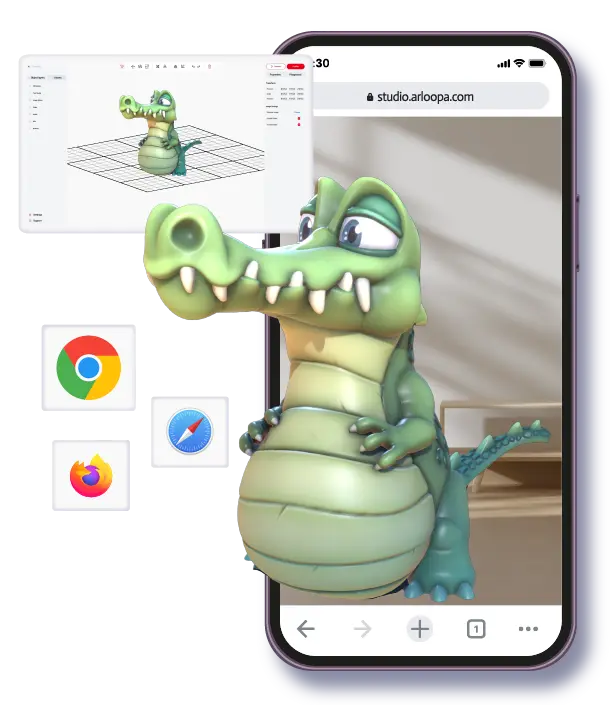
If your main priority is getting the audience into the experience with as little friction as possible, WebAR is often the right first choice. It opens quickly from a browser and works well for campaigns, previews, product storytelling, event activations, and other short-form interactions.
If your priority is a richer recurring environment, deeper account-linked behavior, or a use case that already justifies installation, an app-based route can be stronger. Native apps can support more persistent engagement when the business case is clear enough to earn the install.
- •Choose WebAR when reach and speed matter more than long-session depth.
- •Choose an app when the experience is repeat-use, feature-rich, or tightly tied to an existing app ecosystem.
- •Do not choose a delivery model because it sounds advanced. Choose it because it fits the audience behavior.
User journey
The cost of installation is the biggest strategic difference
Every additional step reduces participation. That is why WebAR performs well in top-of-funnel and campaign contexts. Users can scan, open, and interact immediately. The format respects short attention windows and broad audiences.
App-based AR can still win when the user is willing to install because the value is durable. If the experience is part of an existing app relationship or if the AR function is one piece of a broader product, the install cost may be reasonable. What matters is whether the experience actually earns that cost.
- •Short campaign moments usually do not justify an app install.
- •Recurring product or ecosystem experiences sometimes do.
- •The more you rely on impulse interaction, the stronger the case for browser delivery becomes.
Operational fit
The delivery model also changes how teams publish and maintain content
Browser delivery often gives marketing and content teams more flexibility because updates can happen without app-store review cycles. That matters when launches move quickly or assets need frequent revision. App-based delivery can offer deeper control, but it usually creates a heavier maintenance model that the business should be ready to support.
The right comparison is not just user-facing. It is also about operational cost. Teams should ask which model they can maintain cleanly over time and which one fits the internal ownership structure already in place.
- •WebAR is often easier to update quickly when campaign timing changes.
- •App-based AR is often better when the product already lives inside a maintained application.
- •Publishing workflow should influence the decision as much as front-end capability.
Practical choice
ARLOOPA Studio is useful when you want to validate fit before overcommitting
ARLOOPA Studio helps teams evaluate the browser-first path without forcing them to treat every AR concept like a custom app project. That is especially useful when the real business need is to learn quickly, launch pilots, and confirm whether a broader rollout deserves deeper investment.
If WebAR proves strong, teams can scale it. If a deeper use case emerges, the experience can be reassessed with more confidence. That staged approach is usually more defensible than beginning with the heaviest possible delivery model.
- •Pilot the lower-friction route first when the audience is broad and the use case is campaign-driven.
- •Escalate to app-based logic only when the user journey clearly requires it.
- •Use pricing and demo conversations to scope what the browser-first route can realistically deliver.
Decision framework
The real comparison is not browser versus app, but friction versus depth for the specific job to be done
Teams often frame the question as a technology debate, but the stronger way to compare the two models is to look at what the user needs to achieve. If the user needs a fast, lightweight, one-session interaction, WebAR usually wins because access is immediate. If the user needs repeat use, account-based features, richer performance, or a deeper long-term environment, an app-based model may still be the better tool. The wrong decision usually happens when a team chooses the more impressive technology instead of the one that fits the user journey best.
This decision also affects budgets, approval timelines, and campaign risk. Browser-based AR lowers entry friction and usually speeds up piloting. App-based AR can justify itself when the long-term product experience is central enough to support installation and repeat use. ARLOOPA Studio helps at the evaluation stage by making it easier to prototype what the lightweight path looks like before the team commits to a heavier product build. That practical comparison usually tells stakeholders more than another internal slide deck about the future of immersive technology.
- •Choose WebAR when immediate access matters more than depth.
- •Choose app-based AR when long-session capability and repeat use matter more than friction.
- •Use a pilot to validate which model supports the audience behavior you actually expect.
FAQ
WebAR vs app-based AR FAQ
Is WebAR cheaper than app-based AR?
Often yes at the start, because delivery and iteration can be simpler. The real cost question depends on scope, content, and how much native functionality the experience needs.
Does app-based AR always perform better?
Not necessarily. It can support deeper behavior, but a high-friction app install can reduce participation in campaign-driven use cases.
Which one is better for marketing campaigns?
WebAR is often better for campaign access because users can open the experience without downloading an app first.
Can teams start with WebAR and scale later?
Yes. That is often the most practical path because it lets the team validate audience behavior before committing to a heavier build.
Existing Studio pages
Related Solutions
Use these established Studio pages when you need deeper solution or industry detail beyond this guide.
WebAR Platform Guide
Compare WebAR platforms by mobile access, publishing control, supported formats, and whether a non-technical team can actually run them after launch.
Open pagePricing
Compare ARLOOPA Studio pricing plans for WebAR, geospatial AR, image tracking, and no-code AR creation, and choose the right option for your team or business.
Open pageSchedule a demo
Book a demo with ARLOOPA Studio to see how your team can create no-code augmented reality experiences for marketing, education, events, packaging, and product storytelling.
Open pageProduct Visualization
Help buyers understand products in 3D and AR before purchase. Build product demos, placement previews, and interactive product stories without coding.
Open pageContinue reading
Related Reading
These supporting guides answer the next practical questions readers usually have before launching an AR project.
Best WebAR Platforms
Use this 2026 shortlist guide to compare WebAR platforms by team fit, delivery model, continuity, and whether the workflow can survive after the first pilot.
Read guideCreate AR Without Coding
Follow a realistic no-code workflow for AR creation without getting trapped in custom development from day one.
Read guideWebAR Use Cases
Use these WebAR scenarios to decide where browser-based access has a genuine business advantage.
Read guide