Marker-based AR
Marker-based AR is still one of the clearest ways to control an AR experience
Marker-based AR remains valuable because it gives the creator control over where and when digital content appears. Instead of placing AR freely in space, the experience is anchored to a known printed image or visual marker. That makes it easier to guide the user, connect the digital layer to a physical asset, and control campaign context. For many business teams, that control is a feature rather than a limitation.
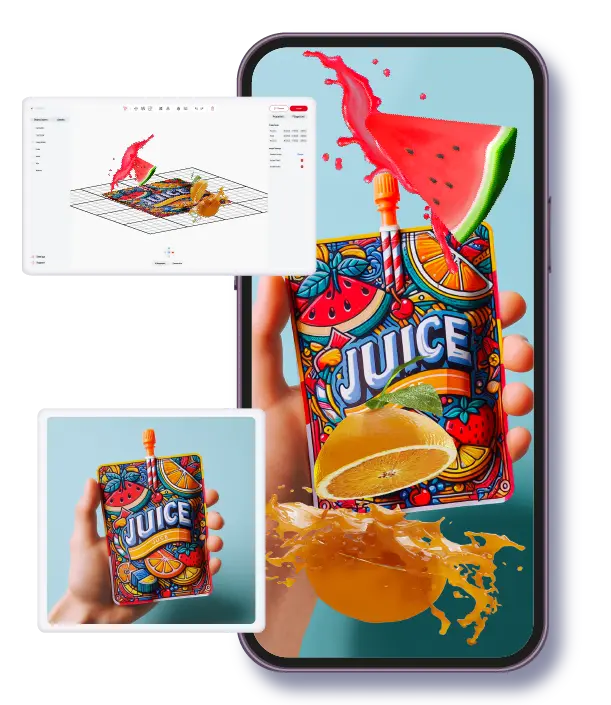
Best for
Packaging, brochures, learning materials, print campaigns, exhibitions, and guided product storytelling.
Strength
The experience is anchored to a known image, so the interaction is easier to frame and explain.
Constraint
The experience depends on users finding and scanning the marker rather than opening AR anywhere.
How it works
Marker-based AR uses a known visual trigger to launch the digital layer
In a marker-based AR workflow, the camera recognizes a specific image, print asset, or marker and uses it as the reference point for the content. The value is precision. The creator knows which physical asset the user should scan, what message appears, and how the digital experience aligns with the real object in front of the user.
That precision is why marker-based AR has remained useful across education, culture, packaging, and print. It creates a clear bridge between physical media and digital content without asking the user to understand spatial placement on their own.
- •The trigger can be a poster, product box, brochure, label, book page, or other designed visual asset.
- •The digital layer can explain, animate, demonstrate, or extend the physical asset’s purpose.
- •The user journey is simple because the call to action can be tied to a visible object.
Business fit
The format is strongest when the physical asset is already part of the journey
Marker-based AR works best when there is already a printed or packaged surface in the user journey. Packaging can trigger ingredient stories, tutorials, or promotional content. Print media can turn flat materials into interactive content. Educational materials can attach explanations to diagrams or pages. Museums and cultural spaces can connect works, labels, or signage to deeper storytelling.
That makes the format particularly effective for organizations that already invest in physical media and want that media to do more work. Instead of replacing the printed asset, marker-based AR upgrades it.
- •Use it when the printed object is already central to the experience.
- •Use it when context and message control matter more than free placement.
- •Use it when you want the audience to discover AR through a tangible object, not just a browser link.
Planning limits
The marker has to be strong enough to scan and meaningful enough to justify the action
Marker-based AR is not automatically effective just because the tracking works. The physical trigger must be visually reliable, easy to discover, and clearly connected to the benefit of scanning it. If users do not understand what they will get from scanning, adoption stays low no matter how polished the AR content is.
The best marker-based projects pair clear creative direction with clear instruction. The physical piece tells the user what to do, why it is worth doing, and what type of content will appear. That clarity is more important than adding extra complexity to the experience itself.
- •Give the audience a clear reason to scan, not just a generic invitation.
- •Design the marker asset with recognition quality in mind, especially for small or busy surfaces.
- •Keep the first interaction focused so the user understands the value immediately.
Workflow
ARLOOPA Studio helps when you need a repeatable marker-based publishing process
ARLOOPA Studio is a practical fit for marker-based AR because the platform already supports image-driven AR creation inside a no-code workflow. That matters when teams need to publish or revise multiple experiences tied to physical assets over time rather than treating every activation like a bespoke experiment.
Once the trigger strategy is clear, the next move is usually to explore the existing solution and industry pages that align with the printed asset itself. Packaging, print media, education, tourism, and real estate all use marker-based logic differently, and those pages go deeper on those business contexts.
- •Use the same Studio workflow across product, educational, and exhibition-based marker experiences.
- •Reduce revision friction when packaging, labels, or print runs require updated AR content.
- •Move from a broad format guide into the more specific solution page once the use case is confirmed.
Execution checklist
Marker-based AR performs better when the physical trigger is designed as carefully as the digital layer
Many marker-based projects fail for simple operational reasons. The printed trigger is too small, too reflective, too visually inconsistent, or placed where people do not naturally pause. In those cases, the tracking problem is not purely technical. It is a design and placement problem. Teams should treat the marker as a functional campaign asset with its own production requirements, quality control, and environmental context.
That makes marker-based AR a strong fit for structured environments like packaging, museums, catalogs, classrooms, and site materials where the team can control how the trigger appears in the real world. ARLOOPA Studio is valuable here because it helps connect the marker workflow to the content workflow. Instead of separating print decisions from AR decisions, the team can plan both together and avoid the last-minute mismatch that often causes a scan experience to underperform.
- •Test the marker at real size, in real lighting, and on the real printed material.
- •Place the scan prompt where users already have attention and enough physical room to interact.
- •Treat marker design as part of campaign production, not as an afterthought.
FAQ
Marker-based AR FAQ
What is marker-based AR?
Marker-based AR uses a known printed image or marker as the trigger and anchor for the digital content shown through the device camera.
Is marker-based AR the same as image tracking AR?
They are closely related. Image tracking is the technical method, while marker-based AR is the broader delivery model built around that trigger.
When is marker-based AR better than surface tracking?
It is better when you want precise control over the trigger, clear context, and a direct link to a physical asset such as packaging or print.
Which industries use marker-based AR most often?
Packaging, print media, education, culture, tourism, and real estate commonly use it because those sectors already depend on physical materials.
Existing Studio pages
Related Solutions
Use these established Studio pages when you need deeper solution or industry detail beyond this guide.
Packaging
Turn packaging into a scan-to-open WebAR channel for product education, brand storytelling, promotions, QR campaigns, and loyalty experiences without an app.
Open pagePrint Media
Add interactive AR to posters, flyers, brochures, catalogs, and cards with WebAR, image tracking, video, 3D, and call-to-action layers that launch from QR codes and links.
Open pageEducation
Create AR lessons, learning cards, classroom posters, and educational WebAR experiences that help students explore concepts in 3D without extra app friction.
Open pageReal Estate
Use augmented reality in real estate to showcase properties, visualize interiors, and help buyers explore spaces, layouts, and development concepts with AR.
Open pageTravel and Tourism
Launch AR city guides, landmark tours, destination storytelling, and geospatial visitor experiences with location-based AR for tourism, culture, and travel teams.
Open pageContinue reading
Related Reading
These supporting guides answer the next practical questions readers usually have before launching an AR project.
Image Tracking AR Guide
Choose image tracking AR when a known visual target should control the timing and context of the experience.
Read guideCreate AR Without Coding
Follow a realistic no-code workflow for AR creation without getting trapped in custom development from day one.
Read guideAR Marketing Guide
Use AR marketing when interaction improves understanding, memory, or action instead of adding novelty for its own sake.
Read guide