Platform comparison
ARLOOPA Studio vs Onirix: Better Choice for WebAR Campaigns and Agencies
ARLOOPA Studio vs Onirix is a particularly important comparison in 2026 because product fit is only part of the decision. Onirix still has meaningful strengths in Spatial AR, wayfinding, and precise tracking, but it also announced its closure in 2025 and says service remains active only until September 1, 2026. ARLOOPA Studio is the safer commercial choice when teams want an active no-code platform with broad AR format support and without closure risk hanging over the buying decision.
Comparison based on publicly available product pages and documentation reviewed on March 20, 2026.
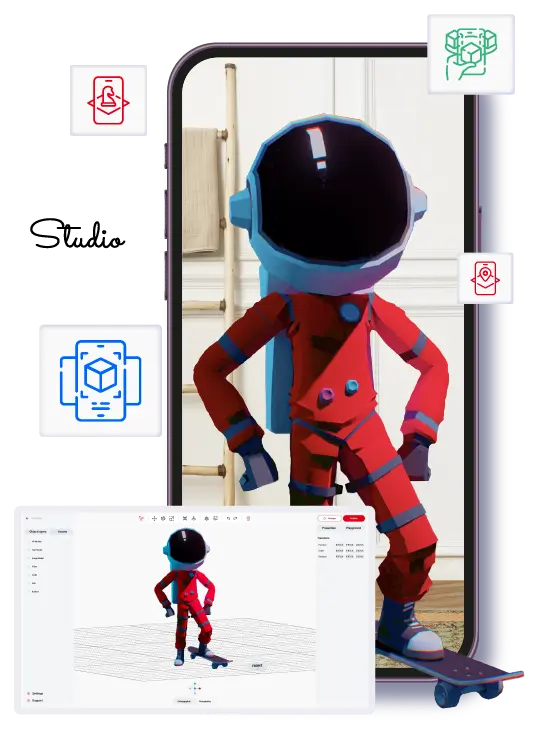
ARLOOPA Studio
Best fit
Teams that want one no-code platform for WebAR, image tracking, surface tracking, face tracking, geospatial AR, white-label app planning, and a publicly promoted Meta Quest app path.
No-code AR creation platform for business, education, events, and marketing.
Onirix
Best fit
Teams with a strong spatial or wayfinding requirement that are comfortable with platform continuity risk.
A WebAR and Spatial AR platform with strong public emphasis on precise tracking, VPS, wayfinding, and mixed web/headset delivery.
Short answer
Choose ARLOOPA Studio when you want an active no-code platform for campaigns, education, tourism, culture, and broader AR rollout planning. Consider Onirix only if your project is unusually dependent on Spatial AR or wayfinding and you are comfortable with platform wind-down risk.
ARLOOPA Studio is usually stronger when
- You want a supported commercial platform rather than one in an orderly shutdown process.
- Your roadmap includes more than spatial AR alone, such as face tracking, WebAR campaigns, or branded-app planning.
- You need a no-code tool that fits agencies, brands, culture, tourism, education, and event teams without continuity risk.
Onirix may fit better when
- The project is heavily centered on Spatial AR, wayfinding, or place-locked visitor guidance.
- You already understand the closure timeline and can tolerate the risk or migration burden.
- The value of Onirix’s spatial strengths clearly outweighs continuity concerns for the specific project.
Feature comparison
Feature comparison: ARLOOPA Studio vs Onirix
These rows reflect what each platform publicly highlights today, with emphasis on what matters to no-code teams choosing a WebAR or broader AR workflow.
Capability
ARLOOPA Studio
Onirix
WebAR / browser delivery
Can teams launch AR experiences directly in the browser without asking end users to install a dedicated app first?
ARLOOPA Studio
WebAR is part of the current Studio product story.
Onirix
The public site explicitly positions Onirix as an AR tool with no apps.
No-code visual builder
Does the public product positioning clearly support drag-and-drop or non-technical creation?
ARLOOPA Studio
The platform is explicitly positioned as no-code.
Onirix
Onirix Studio is positioned as a fast way to configure scenes, though the overall offer feels more enterprise and solution-oriented than a simple marketer-first no-code tool.
Image tracking / marker-based AR
Useful for packaging, print, education, museums, and scan-to-launch brand activations.
ARLOOPA Studio
Image tracking is a core Studio capability.
Onirix
The public site leads with precise tracking, Spatial AR, and combined tracking rather than simple image-based campaign creation.
Surface or world tracking
Important for product placement, room-scale previews, and no-marker browser experiences.
ARLOOPA Studio
Surface tracking is already highlighted on the site.
Onirix
SLAM and spatial tracking are publicly highlighted.
Face tracking / filters
Relevant for beauty, fashion, entertainment, and branded social-style activations.
ARLOOPA Studio
Face tracking is already positioned as a launchable format.
Onirix
Face tracking is not a visible public product pillar.
Geospatial / location-based AR
Relevant when AR content must stay tied to real places, landmarks, or visitor routes.
ARLOOPA Studio
Geospatial and location-based AR are publicly highlighted.
Onirix
Spatial AR and wayfinding are key parts of the public offer.
White-label or branded app path
Does the platform publicly highlight a branded app or white-label route beyond browser delivery?
ARLOOPA Studio
The site includes a white-label app route.
Onirix
The public site focuses on web and spatial AR rather than a branded app builder.
Dedicated public Meta Quest app path
This row refers to a publicly highlighted dedicated Meta Quest app or store-facing app path, not just generic headset compatibility.
ARLOOPA Studio
ARLOOPA publicly highlights a Meta Quest app presence.
Onirix
Onirix says Spatial AR can be consumed in a browser on mobile or headset, but not via a dedicated public Meta Quest app.
Platform status in 2026
Teams should evaluate not just features, but also continuity, support, and whether the hosted workflow is still active.
ARLOOPA Studio
No public wind-down or closure warning is present.
Onirix
Onirix announced closure in September 2025 and says service remains active until September 1, 2026.
Where ARLOOPA wins
Where ARLOOPA Studio is usually the better choice for no-code teams than Onirix
ARLOOPA Studio is the stronger choice for most no-code buyers because it remains an active commercial platform and already covers the AR formats many teams need in one place: WebAR, image tracking, surface tracking, face tracking, geospatial AR, white-label app planning, and a public Meta Quest app path. That matters more in 2026 because continuity is no longer a side issue. It is a core buying variable.
For agencies, brands, tourism teams, museums, and educators, the safer platform is often the better platform. Even if Onirix is strong in Spatial AR and wayfinding, platform closure and reduced support for new accounts create operational risk that many teams do not need to take.
- •You want a supported commercial platform rather than one in an orderly shutdown process.
- •Your roadmap includes more than spatial AR alone, such as face tracking, WebAR campaigns, or branded-app planning.
- •You need a no-code tool that fits agencies, brands, culture, tourism, education, and event teams without continuity risk.
Where the competitor may fit
Where Onirix may still be the better fit
Onirix may still fit better when the project is explicitly built around Spatial AR, precise wayfinding, or location-bound industrial or visitor flows that map closely to its public strengths. If the team has already validated that exact format and has a clear plan for continuity or migration, it can still be relevant in the near term.
But that advantage must be weighed against closure and support constraints. This is not just a feature comparison. It is a delivery-risk comparison.
- •The project is heavily centered on Spatial AR, wayfinding, or place-locked visitor guidance.
- •You already understand the closure timeline and can tolerate the risk or migration burden.
- •The value of Onirix’s spatial strengths clearly outweighs continuity concerns for the specific project.
Buying questions
Questions to ask before choosing between ARLOOPA Studio and Onirix
When continuity risk enters the picture, buyers should become more conservative. Ask not only whether the tool can run the pilot, but whether the team will still trust the platform during rollout, expansion, and support cycles. For many non-technical buyers, that answer alone will narrow the shortlist quickly.
If you still want to evaluate Onirix, test the exact spatial use case that makes it attractive. If the project can be solved with a broader no-code AR platform like ARLOOPA Studio, removing shutdown risk is often the smarter commercial move.
- •Is the project truly dependent on Spatial AR or wayfinding, or could a broader no-code AR platform solve it?
- •What is the continuity plan if the platform is only guaranteed through September 1, 2026?
- •Does the project need face tracking, branded-app planning, or broader campaign support that goes beyond spatial AR?
FAQ
ARLOOPA Studio vs Onirix: Better Choice for WebAR Campaigns and Agencies FAQ
Why is platform continuity so important in ARLOOPA Studio vs Onirix?
Because Onirix publicly announced closure and says service remains active only until September 1, 2026. That makes continuity part of the product evaluation, not a side note.
Is Onirix still worth considering?
It may still be worth considering for very specific Spatial AR or wayfinding projects, but buyers should enter that decision with full awareness of the closure timeline and support limits.
What makes ARLOOPA Studio safer in this comparison?
ARLOOPA Studio remains an active commercial platform and supports a broader no-code AR set without public closure risk.
Which industries are most likely to compare these two tools?
Tourism, culture, education, agencies, and any team evaluating location-tied AR or visitor guidance are likely to compare them.
Studio pages
Related Studio pages
Move from vendor research into the core Studio pages that explain pricing, rollout, and product fit.
ARLOOPA Studio
Create WebAR, image-tracked, markerless, face-tracked, and geospatial AR experiences without code. Build, publish, and manage AR campaigns faster with ARLOOPA Studio.
Open pagePricing
Compare ARLOOPA Studio pricing plans for WebAR, geospatial AR, image tracking, and no-code AR creation, and choose the right option for your team or business.
Open pageSchedule a demo
Book a demo with ARLOOPA Studio to see how your team can create no-code augmented reality experiences for marketing, education, events, packaging, and product storytelling.
Open pageMore comparisons
Related comparisons
Use these head-to-head pages when your shortlist still includes more than one serious platform candidate.
ARLOOPA Studio vs 8th Wall: Best Option After the Hosted Platform Retirement
Compare ARLOOPA Studio with post-hosted 8th Wall for no-code teams after the hosted platform retirement, using a migration and workflow lens instead of the old SaaS feature checklist.
Open comparisonARLOOPA Studio vs Zapworks: Which WebAR Platform Is Better for No-Code Teams?
Compare ARLOOPA Studio and Zapworks for no-code WebAR, tracking breadth, headset paths, and the real workflow tradeoff between a focused AR platform and a broader immersive web stack.
Open comparisonARLOOPA Studio vs UniteAR: Which Zero-Code AR Platform Fits Your Team?
Compare ARLOOPA Studio and UniteAR for zero-code WebAR, image tracking, ground-plane AR, white-label app paths, browser delivery, and broader AR format coverage.
Open comparisonContinue reading
Related reading
These guides answer the next practical questions most buyers ask after the first platform comparison.
Geospatial AR Guide
Use geospatial AR when a real-world location or landmark needs to become part of the narrative, navigation, or activation.
Read guideGeospatial AR Use Cases
Use geospatial AR when real places need context, guidance, or narrative layers that make the visit more meaningful.
Read guideWebAR Platform Comparison
Use this comparison guide to evaluate WebAR platforms by buyer fit, not just browser features.
Read guide